NJDEP Soil Cleanup Standards Explained for New Jersey Homeowners
Understanding NJDEP Soil Cleanup Standards and What They Mean for Your Property
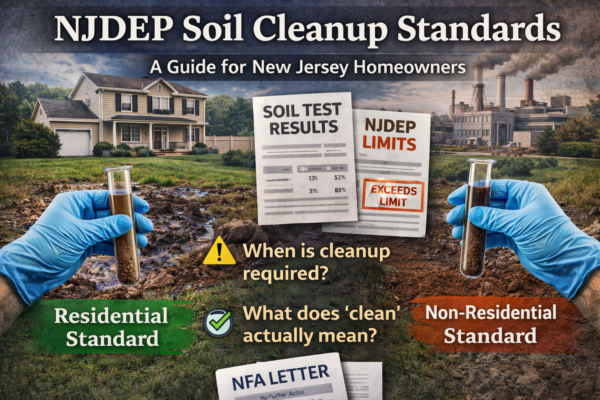
You’ve just been handed a soil remediation report. Or maybe your real estate attorney mentioned “NJDEP standards” and you nodded along, hoping it would make sense later. Here’s the honest truth: these regulations confuse even experienced professionals. But understanding the basics can save you thousands of dollars and a lot of stress. This guide breaks it all down in plain English.
Quick Answer: What Are NJDEP Soil Cleanup Standards?
NJDEP soil cleanup standards are the legal limits for how much contamination can remain in soil after remediation. New Jersey uses separate residential and non-residential criteria; homeowners fall under the stricter residential standard. These limits are published in the NJDEP Soil Remediation Standards and enforced through the Technical Requirements for Site Remediation (N.J.A.C. 7:26E). In most cases, a Subsurface Evaluator oversees the cleanup and certifies compliance.
What Homeowners Actually Want to Know First When Soil Contamination is Found
Most people don’t ask, “What are the NJDEP residential soil remediation standards?” What they actually ask is:
- “Is my property safe?”
- “Do I actually have to clean this up?”
- “How much is this going to cost me?”
- “Will this kill my home sale?”
Those are the right questions. Here’s the short version.
New Jersey has legally defined numerical limits for soil contamination. If contamination on your property, from a leaking oil tank, prior industrial use, or historic fill, exceeds those limits, remediation is required. If it doesn’t exceed them, cleanup may not be necessary at all.
That last part is worth repeating. Not every contaminated property needs full remediation. The NJDEP sets specific numerical criteria for hundreds of individual contaminants. If testing shows your soil meets those criteria, you may be in the clear, even if some contamination is present.
This is why proper soil testing matters so much. You can’t make good decisions without real data.
How NJDEP Soil Cleanup Criteria Actually Work
The Basics of the Standard
The NJDEP publishes numerical soil remediation standards; specific concentration limits for individual contaminants, measured in milligrams per kilogram (mg/kg) of soil. If your soil test results fall below those numbers, your property meets the standard.
There are two main categories:
- Residential Direct Contact Soil Remediation Standards — Apply to properties where people live, play, or garden. These are stricter because children and adults have more direct, sustained contact with residential soil.
- Non-Residential Direct Contact Soil Remediation Standards — Apply to commercial or industrial properties where exposure is more limited.
For homeowners, the residential standard almost always applies.
What Contaminants Are Covered?
If you have an underground oil tank that leaked, you’re primarily looking at petroleum hydrocarbons. That’s the most common contamination scenario we handle in New Jersey.
What Triggers a Soil Cleanup?
Soil remediation is triggered when:
- Soil sample results exceed the NJDEP standard for a contaminant
- Contamination has migrated or is likely to migrate to groundwater
- An NJDEP case has been opened, usually after a spill report or tank closure
- A NJDEP Closure Personnel or Subsurface Evaluator determines if cleanup is required
A NJDEP staff or Subsurface Evaluator typically oversees the process and will issue you a No Further Action (NFA) letter. This system places responsibility on licensed professionals to certify that cleanups are complete and compliant.
The Difference Between Soil and Groundwater Standards
Soil contamination and groundwater contamination are two different problems governed by two different sets of standards.
Soil standards address direct contact, what happens when humans, especially children, touch, ingest, or inhale contaminated soil. These are set by the NJDEP’s Direct Contact Soil Remediation Standards.
Groundwater standards address the quality of water in the saturated zone below your property. The NJDEP’s Groundwater Quality Standards set the permissible limits. Groundwater standards become relevant when:
- Contamination is deep enough to reach the water table
- Your property uses a private well
- The NJDEP identifies an Immediate Environmental Concern (IEC)
The IGW (Impact to Groundwater) Pathway
One commonly misunderstood concept is the Impact to Groundwater (IGW) pathway evaluation. If soil contamination is present at depth, the NJDEP may require an investigation to determine whether contaminants are reaching groundwater, even if the soil surface meets applicable standards.
This matters for oil tank cases specifically. A tank that failed below grade could have released petroleum at depths that pose a groundwater risk. In certain NJ counties, where many homes rely on private wells, this evaluation is taken seriously.
What “Clean” Actually Means Under NJDEP Rules
“Clean” doesn’t mean zero contamination. That’s an important distinction. Under NJDEP rules, a property is considered remediated when it meets the applicable standard for each contaminant of concern. That standard reflects a risk-based threshold, not the complete absence of all chemicals.
What Documentation Proves Soil Cleanup Is Complete in New Jersey?
- Soil sample results showing concentrations below NJDEP residential criteria
- No Further Action Letter (NFA) issued by the NJDEP
- NJDEP case number closure where applicable
- Lab certification — NJDEP only accepts results from NJDEP-certified laboratories
This documentation matters enormously in real estate transactions. Buyers, lenders, and title companies want to see the NFA letter. Without it, a contamination history can stall or kill a sale, even when the actual environmental risk is minimal.
What About Clean Fill?
If contaminated soil is excavated, it must be disposed of at a licensed facility. Any replacement soil brought in must meet NJDEP clean fill standards. Using unpermitted fill is a serious regulatory violation that can introduce new contamination and create significant liability.
NJ Homeowners Face Stricter Soil Standards
New Jersey has some of the most protective environmental regulations in the country. That’s partly a product of the state’s industrial history, and it means homeowners here face more scrutiny than in most states.
What We See Most Often in New Jersey
The most common soil contamination scenario involves residential heating oil tanks. Homes built before the 1980s frequently relied on underground fuel oil tanks. Many were abandoned in place rather than properly removed. Over time, steel tanks corrode. When they leak, petroleum hydrocarbons contaminate the surrounding soil.
We also commonly see contamination from:
- Historic fill — former industrial or urban-origin material used in residential development
- Agricultural chemical use — pesticides and herbicides common on older farmland
- Above-ground tank spills — less frequent, but still a potential remediation trigger
NJDEP Records and Case Numbers
If your property has an existing NJDEP case number, that requires immediate attention. NJDEP maintains searchable environmental records online. If a case is open, active remediation may be legally required. Failure to act can result in escalating annual remediation fees.
Understanding your property’s NJDEP status before buying, selling, or refinancing is critical. We recommend an NJDEP records search as a baseline step for any property with unknown tank or contamination history in our region.
How ERC Environmental Handles the Process
ERC Environmental has been working in New Jersey for over 30 years. We specialize in oil tank removal, soil testing, and soil remediation for residential and light commercial properties.
Here’s what sets our process apart:
- Transparent pricing. We quote honestly and upfront, no surprises after the excavator is on-site.
- Subsurface Evaluation coordination. We have licensed NJDEP subsurface evaluators on staff to ensure every project meets NJDEP standards and is properly documented.
- Complete documentation. You receive a full file: soil results from NJDEP-certified labs, remediation records, and the NFA letter so your property is clearly documented for any future sale or refinancing.
- We turn away work we don’t believe is needed. If your soil tests come back within standards, we’ll tell you. We’re not in the business of creating unnecessary projects.
We serve New Jersey. We answer the phone, return calls quickly, and show up on time. After 30 years, that’s still the standard.
Frequently Asked Questions About NJDEP Soil Remediation Standards
What is the NJDEP residential soil remediation standard?
It’s the maximum allowable concentration of a contaminant in residential soil, measured in PPM. The remediation limit is 5,300 ppm. If your soil is below that number, no cleanup is required for that contaminant.
Do I need a Subsurface Evaluator for my soil remediation project?
Yes. New Jersey requires that a Subsurface Evaluator oversee and certify any formal remediation.
What happens if my property doesn’t meet NJDEP standards?
Remediation is required. That typically means excavating and disposing of contaminated soil, then replacing it with NJDEP-compliant clean fill.
How long does residential remediation take in New Jersey?
Most residential oil tank remediation projects are completed within one to three days of active work. Regulatory documentation and the NFA letter issuance typically add several additional weeks.
What is a No Further Action Letter (NFA)?
An NFA letter is the formal certification issued by the NJDEP confirming the remediation is complete and the property meets NJDEP standards. It’s the document needed to close an NJDEP case and demonstrate compliance to buyers, lenders, and title companies.
How to Move Forward With Soil Remediation in New Jersey
If you’re dealing with soil contamination in New Jersey, whether it’s a leaking tank, a property sale, or an open NJDEP case, don’t try to navigate it alone.
ERC Environmental provides honest assessments, NJDEP-compliant remediation, and complete documentation for homeowners in New Jersey. We will tell you what you actually need and what you don’t.
Call us or reach out online. We respond quickly, quote transparently, and get the work done right. You deserve straight answers. That’s what we’re here for.
Or fill out the form below and we’ll respond within one business day