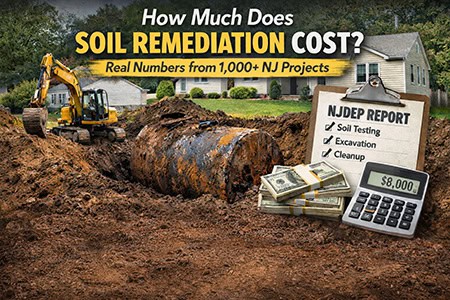
How Much Does Soil Remediation Cost? Real Numbers from 1,000+ NJ Projects
Everything You Need to Know About Oil Tank Remediation Cost
You just found out your soil is contaminated. Your stomach drops. You are picturing five-figure bills, torn-up yards, and months of construction.
Here is what most homeowners do not know: it is rarely the nightmare scenario you are imagining. Most residential oil contamination costs between $3,000–$12,000 to fix properly. Let’s break down real costs, what drives them, and what actually happens.
Quick Answer:
Soil remediation cost in New Jersey typically ranges from $3,000–$15,000, depending on contamination levels and soil volume removed. Most residential oil tank leak cleanups fall between $8,000–$10,000. At ERC Environmental, we provide flat-rate pricing with no surprise charges, so you know the exact cost before we start.
What You Are Really Asking: “How Bad Is This Going to Be?”
Let’s start with what you actually want to know.
You are not wondering about per-cubic-yard disposal rates. You want to know if this leak is going to wreck your budget. Fair question.
Here’s the honest answer:
- Most soil contamination costs $8,000–$10,000 to remediate
- Simple cases where the oil tank leak is relatively contained can be under $4,000
- Complex cases with extensive soil remediation necessary from an oil tank leak rarely exceed $15,000 for residential properties
Understanding what you are paying for makes it less scary.
The Good News if Your Oil Tank Has Leaked:
- Costs are predictable once we test your soil
- The work takes 1–3 days, not months
- Your yard recovers in one growing season
- It is fixable with a clear endpoint
What Actually Determines Your Soil Remediation Cost in New Jersey:
- Contamination levels (measured in parts per million)
- Volume of affected soil (usually 10–40 cubic yards)
- Depth of contamination (surface vs. deep soil)
- NJDEP cleanup threshold (are you over the residential limit?)
- Property access (can trucks and machinery reach the area?)
The key insight: most residential oil leaks do not exceed NJDEP’s harmful threshold. That means simpler cleanup, lower costs, and faster timelines.
The Real Cost Breakdown: What Drives the Price of a Soil Clean Up
Let’s get specific about contaminated soil remediation costs in NJ.
Low-Level Soil Contamination: $3,000–$6,000
This covers most small oil tank leaks caught early:
- 10–20 cubic yards of soil removal
- Lab testing and documentation
- Proper disposal at approved facilities
- Site restoration (grading, topsoil)
- NJDEP reporting and documentation
What this looks like: A slow leak from a fill pipe. Contamination is shallow and limited. Your NJDEP case manager confirms levels are under the residential threshold.
Moderate Soil Contamination: $6,000–$12,000
This applies to larger spills or older leaks from an underground residential oil tank, the most common scenario:
- 20–40 cubic yards of soil removal
- Multiple test samples required
- Possible groundwater sampling
- Additional NJDEP reporting
- More extensive site restoration
What this looks like: An underground tank leaked for several years. Contamination spread laterally. You need confirmation that groundwater is not affected.
Complex Soil Remediation: $12,000–$25,000+
This is the minority of cases:
- 40+ cubic yards of contaminated soil
- Groundwater contamination present
- Long-term monitoring required
- Multiple phases of cleanup
What this looks like: Severe leak, delayed discovery, contamination migrated. This is rare for residential properties but does happen.
What Is Included in Our Soil Remediation Pricing:
- All soil testing through NJDEP-certified labs
- Excavation and removal
- Transportation and disposal fees
- Site restoration with clean fill and topsoil
- Complete NJDEP documentation
- Case management through closure
What Is NOT Included:
- Oil tank removal itself (typically $2,000)
- Initial soil testing from tank removal
- Property damage unrelated to remediation
- Premium landscaping beyond basic restoration
Here’s why this matters: some companies quote “remediation” but do not include testing, disposal, or documentation. You get hit with add-ons later. We include everything in our flat-rate quote.
Why Insurance Usually Does Not Cover Soil Remediation for A Leaked Oil Tank
Let’s address the question everyone asks: “Will my homeowner’s insurance pay for soil remediation?”
The short answer: probably not.
Why Insurance Denies Most Soil Remediation Claims:
- Gradual damage exclusion (most policies exclude slow leaks over time)
- Maintenance-related issues (insurers consider tank maintenance your responsibility)
- Pollution exclusions (many policies specifically exclude environmental contamination)
- Tank age clauses (some policies will not cover tanks over certain ages)
The reality: Insurance is designed for sudden, accidental events such as a tree falling on your house, not a tank that slowly leaked over five years.
When Insurance MIGHT Cover Soil Remediation Costs:
- You have a specific oil tank endorsement (rare but exists)
- The leak was caused by a covered peril (lightning strike, vehicle impact)
- You can prove sudden failure (tank collapsed during a storm)
Even in these cases, you will likely fight for coverage. We have seen it go both ways, but we recommend assuming you will pay out of pocket.
The Financial Reality:
Most homeowners finance soil remediation one of three ways:
- Pay upfront (less common but avoids interest)
- Home equity line of credit (common for $10,000+ costs)
- Personal loan or credit card (for smaller amounts)
Some contractors offer payment plans. We do not, because we have found that financing through your own bank typically gets you better rates than contractor financing.
The bottom line: Budget for this expense. It is not fun, but it is fixable and finite.
New Jersey: Soil Remediation Scenarios We See Most Often
Northern New Jersey has unique soil conditions that affect remediation costs.
Sussex County homes often have:
- Rocky, glacial till soil (harder to excavate, affects cost)
- High water tables (groundwater sampling more critical)
- Older underground tanks (installed 1950s–1970s)
- Steep terrain (access can be challenging)
Morris County properties typically feature:
- Clay-heavy soil (contamination spreads differently)
- Proximity to reservoirs (stricter NJDEP oversight)
- Historic tank installations (longer leak timelines)
Warren County locations commonly have:
- Well water dependency (groundwater protection is priority)
- Agricultural history (more aboveground tank leaks)
- Varied soil composition (testing is essential)
What This Means for the Cost to Remediate Contaminated Soil:
Soil type changes how oil moves underground. Clay soil limits contamination spread (usually lower costs). Sandy soil lets it migrate further (potentially higher costs). Rocky soil requires different excavation equipment (may add to labor costs).
We have done over 1,000 remediation projects in New Jersey counties. We know which soil types are in Newton, Sparta, Hopatcong, Hackettstown, Mount Olive, and Roxbury. That knowledge means accurate quotes and no surprises.
Local Regulatory Context: NJDEP requires remediation above 5,300 ppm for residential soil.
These are not obstacles. They are standard procedures. But they affect timeline and documentation requirements, which we handle as part of our service.
How ERC Environmental Approaches Soil Remediation
Here is how we handle oil contaminated soil remediation cost and why it matters to your final bill.
Flat-Rate Pricing
We quote the full job upfront. No hourly rates. No “we will see when we dig” pricing. You know the cost before we start.
Full Documentation Included
Every soil remediation project includes:
- Chain-of-custody for soil samples
- Lab testing by NJDEP-certified facilities
- Before and after photographs
- Detailed remediation reports
- NJDEP case closure support
Why does this matter? Because incomplete documentation means your case stays open. That affects property sales, refinancing, and your peace of mind.
We do not charge extra for paperwork. It is part of the job.
30+ Years of Local Experience
We have been remediating oil tank leaks and contaminated soil in New Jersey since before the current NJDEP regulations existed. We know:
- Which disposal facilities accept different contamination levels
- How bedrock affects excavation
- What water table issues look like
- When wells need priority testing
What We Do Not Do:
- We do not scare homeowners into unnecessary cleanups
- We do not recommend remediation if levels are acceptable
- We do not upsell services you do not need
- We do not disappear after the job
Why We Are Transparent About Soil Remediation Costs:
Because surprises destroy trust. You are already dealing with contamination you did not cause. You deserve to know exactly what this will cost and why.
Common Questions About Soil Remediation Costs
How long does soil remediation take?
Most residential projects take 1–2 days for excavation and removal. NJDEP approval and case closure take 3–6 months. That timeline does not mean work happening at your house, it is paperwork processing.
Will my yard be destroyed?
We excavate only contaminated soil. Most homeowners lose a 10×10 to 15×15 area temporarily. We restore it with clean fill and topsoil. Grass grows back in one season. You will not see evidence of the work within a year.
Can I sell my house while contaminated soil is being remediated?
Yes. Many homeowners complete remediation as part of their sale. Buyers appreciate documented cleanup. An open NJDEP case is manageable with proper documentation and a clear timeline. In fact, a completed remediation often makes the property easier to sell.
What if my neighbors have well water?
We test surrounding wells as part of the remediation process. NJDEP requires this in certain scenarios. The good news: residential heating oil contamination rarely affects nearby wells unless contamination is severe and groundwater is shallow.
Can I clean up an oil tank leak myself to save money?
Legally, no. NJ requires licensed contractors for soil remediation. Even if it were legal, you would need specialized equipment, disposal facility relationships, and NJDEP documentation expertise. DIY attempts usually cost more when homeowners bring us in to fix them.
What happens if I do not remediate the soil surrounding a leaked underground oil tank?
If contamination is above NJDEP thresholds, you are required to remediate. An open NJDEP case follows your property. It shows up in title searches. Buyers will discover it. Banks may refuse mortgages. And the problem does not go away, it often gets worse and more expensive.
What to Do Next if Your Oil Tank Has Leaked
If you are in New Jersey and dealing with oil contamination, here is your path forward:
Step 1: Get your soil test results reviewed by an experienced professional. We will tell you honestly whether remediation is required or recommended.
Step 2: Understand your real costs. We provide detailed, flat-rate quotes that include everything, no surprises.
Step 3: Choose a contractor who has done this hundreds of times and can guide you through NJDEP requirements efficiently.
At ERC Environmental, we provide fast quotes, clear timelines, and no-surprise pricing. We have been serving New Jersey for over 30 years.
Here is what honest pricing looks like:
- We tell you the full cost upfront
- We include all testing, disposal, and documentation
- We do not change prices mid-project
- We walk you through what you are paying for
Yes, soil remediation costs money. But knowing exactly what you are spending, and why, makes it manageable.
Call us at 877-440-8265 or submit a webform online. We will get back to you within 24 hours. And we will answer every question you have because dealing with soil contamination is stressful enough. You should not have to guess about costs too.
Or fill out the form below and we’ll respond within one business day