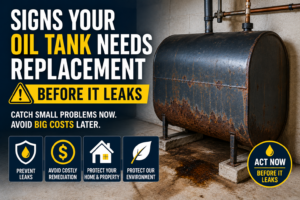
Signs Your Oil Tank Needs Replacement (Before It Leaks)
Warning Signs Your Oil Tank Should Be Replaced Before It Leaks
Quick Answer:
Steel aboveground oil tanks typically last 15-20 years. Underground steel tanks have a similar lifespan and many installed before 1990 are already well past it. Replace your aboveground tank if you see exterior rust that’s pitting or flaking, wet spots near fittings, corroded legs, or frequent filter clogging. For underground tanks, watch for unexplained fuel loss, a petroleum smell near the fill or vent pipe, dead vegetation above the tank area, or a failed pressure test. In New Jersey, any confirmed petroleum release must be reported to the NJDEP.
How to Know If Your Oil Tank Is Becoming a Liability
When homeowners call us about their oil tank, there’s almost always the same question underneath every question: Am I sitting on a problem that’s going to get much worse?
That concern is reasonable. A leaking oil tank in New Jersey isn’t just a maintenance headache. It means potentially contaminated soil, possible groundwater impacts, NJDEP involvement, and remediation costs that can dwarf what it would have cost to replace the tank before it failed.
A few things worth understanding from the start:
- Replacement is almost always cheaper than remediation. A new aboveground tank typically runs $1,500-$3,500 installed. Soil remediation can reach $10,000-$50,000 or more depending on how far contamination has spread and which pathways are involved.
- Aboveground and underground tanks fail differently. The warning signs don’t look the same, and knowing which type you have changes what you’re looking for.
- Most failures are preventable if you catch the signs before the tank gives out completely.
The goal of this guide is to help you read those signs: clearly, without alarm, and with the context to know what to do next.
Warning Signs for Aboveground Oil Tanks
Aboveground tanks have one significant advantage over underground tanks: you can actually see them. Most are located in basements, utility rooms, or garages. The problem is that homeowners walk past them every heating season without genuinely looking at them.
Here’s what to look for:
Exterior rust that’s more than surface-level
A small amount of surface oxidation on an older steel tank isn’t unusual. What is unusual, and worth acting on, is rust that’s pitting, flaking, or spreading across large portions of the tank surface. That kind of corrosion isn’t cosmetic. It’s structural deterioration.
Wet spots, staining, or oily residue near fittings
Examine the fittings, the fuel gauge, the fill pipe, and the return line. Any wet spot, oily sheen, or dark staining around those connections indicates the product is seeping out. Slow seeps don’t stay slow.
Corroded, cracked, or uneven legs
The legs support the full weight of a tank that can hold hundreds of gallons of fuel. If those legs are corroding through, or the tank is sitting noticeably off-level, that puts uneven stress on the tank bottom, which is exactly where most aboveground failures start. An off-balance tank should be assessed immediately.
Frequent filter clogging or burner delivery errors
If you’re replacing the oil filter more often than usual, or your heating system is throwing fuel delivery errors, internal sludge buildup may be the cause. Sludge accumulates as tanks age and interior coatings degrade. It’s a sign the tank is nearing the end of its useful life.
A yellowed, cloudy, or fouled sight gauge
The sight gauge on the side of the tank should be relatively clear. Heavy yellowing, cloudiness, or visible contamination inside the gauge often indicates long-term internal degradation and should be evaluated by a professional.
Any visible seam separation or cracking
If you see separation along a seam or any visible cracking in the tank wall, stop using the tank and call a licensed contractor immediately. A tank with visible structural failure is not safe to continue fueling.
Warning Signs for Underground Oil Tanks
Underground tanks are harder to monitor, which is a large part of why they tend to cause more expensive problems when they fail. You can’t see what’s happening to the steel several feet below grade. But the ground and your heating system will often give you signals if you know what you’re looking for.
Unexplained increase in heating oil consumption
If you’re going through oil faster than previous winters without a change in usage habits or an unusually cold season, fuel may be leaking out of the tank before it ever reaches the burner. This is one of the more reliable early indicators of a failing underground tank.
A persistent petroleum smell
An oil smell near the fill pipe, vent pipe, or anywhere in the surrounding yard is a serious warning sign. If the smell is rising through the soil, the product may already be releasing into the ground.
Dead or dying vegetation over the tank area
Petroleum is toxic to plant life. A patch of dead or dying grass directly above where a buried tank is located, particularly if it appears without obvious explanation, warrants immediate attention and a professional evaluation.
Inability to fill the tank to its rated capacity
If your delivery driver is having trouble getting the tank to accept as much fuel as it used to, the tank may have collapsed internally or developed structural damage that’s displacing volume.
Corrosion at the fill or vent pipes
The fill and vent pipes are the visible surface access points for a buried tank. Heavy corrosion at those above-grade connections often reflects what’s happening much deeper in the tank body.
A failed pressure or integrity test
A professional pressure test is the most definitive way to assess the condition of an underground tank. If the tank fails, complete oil tank removal is required. There is no patching a failed underground tank in New Jersey.
Oil Tank Lifespan: What the Numbers Actually Tell You
The lifespan of any oil tank depends on material, installation quality, maintenance history, and, for underground tanks, the chemistry of the surrounding soil. Here are general benchmarks:
| Tank Type | Typical Lifespan |
| Standard steel aboveground | 15-20 years |
| Steel underground | 15-25 years |
| Fiberglass underground | 30-40 years |
| Double-walled steel | 20-30 years |
A few things NJ homeowners should factor in:
- Many homes in New Jersey still have tanks installed in the 1970s and 1980s. Those tanks are 40-50 years old. Age alone is grounds for a professional inspection, even without obvious symptoms.
- Soil chemistry matters for underground tanks. Acidic and clay-heavy soils, both common in parts of northern New Jersey, accelerate corrosion on steel tank exteriors.
- If you don’t know when your tank was installed, check property records, home inspection reports, or your oil delivery history. Your fuel supplier may have records going back decades.
There’s no legal requirement in New Jersey to replace a tank based on age alone. But the risk calculation changes significantly once you’re past 20-25 years on a standard steel tank.
NJDEP Rules for Oil Tank Leaks and Replacement Work
New Jersey has some of the most detailed environmental regulations in the country around petroleum storage tanks. That’s worth understanding, not because it should alarm you, but because it shapes your obligations and your options.
Any confirmed petroleum release must be reported to the NJDEP through the NJDEP Site Remediation Program’s discharge reporting system. This is a legal obligation, and delays in reporting can increase both your regulatory exposure and the ultimate cost of cleanup.
Aboveground tanks that release product during replacement are also subject to NJDEP oversight under the Technical Requirements for Site Remediation, N.J.A.C. 7:26E. A licensed contractor will handle the required documentation, but it’s worth knowing this framework exists.
All tank replacement work in NJ requires a licensed contractor and proper permits. This is not a DIY project, legally or practically.
The practical takeaway: if your tank is leaking or you have reason to believe it might be, the clock has already started. Moving quickly with licensed help is always better than waiting.
How ERC Environmental Handles Tank Assessment and Replacement in NJ
We’ve been doing oil tank work in New Jersey for over 30 years. Here’s how we approach it.
We assess before we recommend. If you call us about a tank that might need replacing, we look at it honestly. If it doesn’t need to be replaced yet, we’ll tell you that. We’d rather give you an accurate picture than sell you a job you don’t need.
Transparent rate pricing, confirmed before we start. You’ll know exactly what the job costs before the truck pulls up. There are no surprise line items added after the work begins.
Full documentation on every job. Every replacement we complete is documented properly, including any required NJDEP notifications. You’ll have the paperwork you need for your own records and for any future real estate transaction.
Honest evaluation after removal. When we pull a tank, above or below ground, we look at what we find and tell you the truth about it. If site conditions warrant soil remediation, we’ll explain why. If they don’t, we’ll say that too.
ERC Environmental serves homeowners throughout New Jersey, with regular work across New Jersey.
Frequently Asked Questions About Oil Tank Replacement in NJ
How much does oil tank replacement cost in NJ? Aboveground tank replacement typically runs $1,500-$3,500 installed, depending on tank size and site access. Underground removal and replacement is more involved, often $1,800–$3,000 or higher, because excavation is required. If contamination is found during removal, remediation is a separate cost priced based on extent.
Does homeowners insurance cover oil tank replacement? Generally, no. Standard homeowners policies don’t cover replacement due to age or normal corrosion. Some policies include limited pollution liability provisions, but the specifics vary considerably. Read your policy carefully and call your carrier directly, don’t assume you’re covered until you verify.
How long does oil tank replacement take? An aboveground replacement is typically a one-day job. Underground removal and replacement involves excavation and usually takes one to three days depending on site conditions and access.
What’s the most common oil tank size in NJ homes? The 275-gallon aboveground tank is by far the most common size in northern New Jersey. Some older properties, especially those with larger heating loads, have 500- or 1,000-gallon underground tanks.
Can I replace my oil tank myself in NJ? No. Oil tank installation and removal in New Jersey must be performed by a licensed contractor. Permits are required, and unpermitted work creates liability, especially if contamination is later discovered.
Get Your Oil Tank Assessed Before a Leak Becomes a Cleanup Problem
If something in this guide sounds familiar, rust you’ve been meaning to look at more closely, a petroleum smell you’ve been explaining away, or a tank whose installation date you genuinely can’t pin down, the right move is a professional evaluation.
ERC Environmental serves homeowners throughout New Jersey with honest, transparent rate oil tank services. We’ll tell you exactly what we find. If replacement makes sense, we’ll give you a clear price and a straightforward timeline. If it doesn’t, we’ll tell you that instead.
Call us at 877-440-8265 or request a quote online. No pressure, no obligation, no surprises.
Or fill out the form below and we’ll respond within one business day