Oil to Gas Conversion Cost in NJ: Full Breakdown
What It Really Costs to Convert From Oil to Gas in New Jersey
You’ve been watching heating oil prices spike every winter, and you’re done. Or maybe you’re in the middle of selling your home and just discovered the oil tank is more complicated than you expected. Either way, you want real numbers, not a range so wide it doesn’t help you plan. This guide breaks down every cost component in a New Jersey oil to gas conversion, so you know exactly where your project falls before you start making calls.
What Does It Cost to Convert Oil to Gas in NJ? Quick Answer
In New Jersey, converting from oil to gas heat typically costs $12,000–$18,000 for a complete project. That range includes a new gas boiler or furnace, interior gas piping, permits, and oil tank decommissioning. Homeowners who already have a natural gas line on the street often pay closer to $8,000–$12,000. The biggest cost variables are whether gas needs to be run from the street, the age and condition of your existing heating equipment, and whether your oil tank requires soil testing after removal.
What NJ Homeowners Actually Want to Know About Converting to Gas
When New Jersey homeowners ask about converting from oil to gas, three questions are really driving it:
- Will this actually save me money long-term?
- What is the total out-of-pocket cost, including everything?
- What happens to my oil tank?
That last question is the one most HVAC contractors won’t answer, because it’s not their job. But it’s often the variable that determines whether your conversion costs $8,000 or $18,000. Address it upfront.
On savings: Natural gas is generally cheaper per BTU than heating oil in New Jersey. Most homeowners recoup their conversion investment within five to ten years, depending on how much they heat and what fuel prices do. PSE&G offers rebates of $300–$600 for qualifying high-efficiency gas equipment, which meaningfully reduces your upfront cost.
On total cost: Get quotes that include everything: HVAC equipment, labor, gas line work, permits, and oil tank removal. Many homeowners receive a solid HVAC quote, feel confident, and then get surprised when the tank work arrives as a separate bill. Plan for the full picture from the start. It avoids budget shock and scheduling delays down the road.
Full Cost Breakdown of Converting to Gas in NJ: Every Line Item
Here is how converting from oil to gas heat breaks down in New Jersey, component by component.
New Gas Boiler or Furnace: $3,500–$7,500
This is typically the largest single cost in the project. The price depends on several factors:
- System type: Most older New Jersey homes heat with a boiler connected to radiators or baseboard hot water. Boilers cost more than forced hot air furnaces but are the right choice for these homes. Don’t let anyone sell you a furnace when your home is set up for a boiler.
- Efficiency rating: High-efficiency condensing boilers (90%+ AFUE) cost more upfront but qualify for PSE&G rebates and lower your fuel bills year over year.
- Sizing: A correctly sized system is critical. Oversized boilers short-cycle, wear out faster, and waste fuel. Push your contractor to perform a proper load calculation.
Good news: your existing radiators, baseboard units, and distribution pipes almost always stay in place. You are replacing the heat source, not gutting the system.
Interior Gas Piping: $500–$1,500
This covers running gas lines from the meter to your new boiler inside the home. Cost depends on distance, accessibility, and whether any walls or floors need to be opened to route the pipe properly.
Running Gas from the Street: $0–$3,000+
If your home does not have an existing natural gas service connection, PSE&G needs to extend a line from the street main to your house. Cost varies widely based on how close the main is and whether the utility subsidizes new connections in your area. Confirm availability with PSE&G before requesting any HVAC quotes. It is the most important first step.
Permits: $150–$600
Every heating system replacement in New Jersey requires permits. This is not optional. Your contractor should pull them. If they suggest skipping it, that is a serious red flag. Permit costs vary by municipality but typically run $200–$600.
Oil Tank Removal: $1,000–$3,500+
This is the line item most HVAC contractors leave off their quotes. Once you convert to gas, your oil tank, underground or above ground, must be properly decommissioned under NJDEP guidelines. We cover this in detail in the next section.
Water Heater Replacement: $800–$2,500
Many oil-heated homes use an oil-fired indirect water heater connected to the boiler. Once the boiler is gone, that water heater needs a new heat source. Bundling a gas water heater with your boiler replacement saves on labor and minimizes disruption to your household.
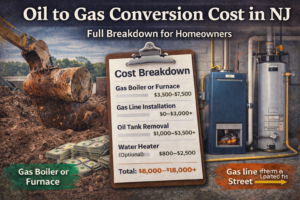
Full Gas Conversion Cost Summary
| Component | Typical NJ Cost Range |
| Gas boiler or furnace | $3,500–$7,500 |
| Interior gas piping | $500–$1,500 |
| Street gas service (if needed) | $0–$3,000+ |
| Permits | $150–$600 |
| Oil tank removal | $1,000–$3,500+ |
| Water heater (optional) | $800–$2,500 |
| Total (typical full project) | $5,800–$18,600+ |
Most NJ homeowners with an existing gas line at the street land between $8,000 and $12,000 for a complete, properly permitted conversion.
The Oil Tank Factor: What Happens to Your Tank
This section deserves its own space because it is consistently the most misunderstood part of any oil to gas conversion and the most likely source of budget surprises.
Why You Cannot Leave the Tank Behind
An undocumented oil tank is a liability, even if it has been empty for years. New Jersey homebuyers and their lenders routinely require written documentation that oil tanks have been properly removed or decommissioned. If you convert to gas now and leave the tank unaddressed, it becomes your problem at the next sale, often at the worst possible moment.
What About Soil Contamination?
Underground storage tanks sometimes leak before they are removed. When ERC removes an underground tank in New Jersey, a visual inspection of the soil is performed from beneath and around the tank as standard practice. Here is what the results mean for your project cost:
- Clean soil: No additional cost beyond removal. You receive a closure report.
- Minor contamination: Soil excavation and disposal typically adds $2,000–$8,000 to the project.
- Significant contamination: Will require NJDEP case opening and a NJDEP subsurface evaluator onsite. Costs can range from $10,000 to $40,000 or more. This scenario is uncommon in residential settings, but it does happen.
The honest reality: most residential tanks we remove show clean or minimally impacted soil. But the only way to confirm that is to test. Any contractor who guarantees clean soil before excavation is not giving you straight information.
Above-Ground Tanks
Simpler and lower risk than underground tanks, but still subject to NJDEP requirements. Proper draining, cleaning, and documentation are required. Do not let anyone leave an above-ground tank in your basement without certified paperwork, it matters to your future buyers and lenders.
Unique Considerations for Converting to Gas in NJ
New Jersey has its own character that directly affects every oil to gas conversion.
Gas availability is not universal here. Many homes in rural Sussex County, Branchville, Newton, parts of Hardystown, do not sit near PSE&G natural gas mains. If gas is not available at the street, propane is the realistic alternative, and that is a different project with different economics. One phone call to your utility before requesting quotes can save you significant time.
Suburban Morris County and Bergen County homeowners typically have natural gas service already available. For these homeowners, the conversion is more straightforward and total costs tend to land at the lower end of the range.
Rural Sussex County conversions involve more variables; potential absence of gas service, aging buried tanks, and less predictable site conditions. Build a conservative budget and make sure soil testing is explicitly included in any tank removal quote you receive.
What ERC Environmental brings to your conversion:
- Transparent pricing on oil tank removal, no mid-project surprises
- Soil Sampling included in every underground tank removal as standard practice
- 30+ years of experience serving New Jersey
- NJDEP-compliant documentation so your project has a clean paper trail for future buyers and lenders
- Fast scheduling and quick callbacks: we know you’re coordinating with an HVAC contractor on a deadline
Frequently Asked Questions About Gas Conversion
Is there a free oil to gas conversion program in NJ?
PSE&G and other New Jersey utilities offer equipment rebates; typically $300–$600 for qualifying high-efficiency systems. A fully subsidized free conversion program is not widely available in New Jersey. Be skeptical of any offer framed that way; the fine print rarely holds up.
Can I keep my existing radiators when I switch to gas?
Yes, in nearly every case. If you replace an oil boiler with a gas boiler, your radiators, baseboard heaters, and existing piping remain in place. You are changing the heat source, not the distribution system. This is one of the most common misconceptions homeowners have when researching conversions.
Does my oil tank have to be removed when I convert?
It must be properly decommissioned, which typically means removal. In New Jersey, an undocumented oil tank creates real liability, particularly at resale. Removal paired with soil testing and a closure report is what lenders and buyers expect to see.
How long does the full conversion take?
A boiler replacement typically takes one to two days for your HVAC contractor. Oil tank removal typically takes one day. If soil contamination is found, remediation timelines range from a few days to several weeks depending on the extent of the issue.
Does converting to gas increase my home value in NJ?
Most real estate professionals in New Jersey report that gas-heated homes sell more easily than oil-heated homes, particularly in suburban markets. The absence of an outstanding oil tank issue also removes a common sticking point for buyers and lenders at closing.
How to Start Your Oil-to-Gas Conversion Without Cost Surprises
If you’re planning an oil to gas conversion in New Jersey, the smartest first move is to get clarity on your oil tank situation before you lock in an HVAC contractor’s timeline. A tank that hasn’t been accounted for can delay your project, or add costs you weren’t budgeting for.
ERC Environmental provides fast quotes, honest assessments, and transparent pricing on oil tank removal and decommissioning throughout New Jersey. We’ll tell you exactly what you’re dealing with, including whether your soil is clean, so you can move your conversion forward without surprises.
Call us or request a quote online. We return calls promptly, give straight answers, and will never recommend work you don’t need.
Or fill out the form below and we’ll respond within one business day