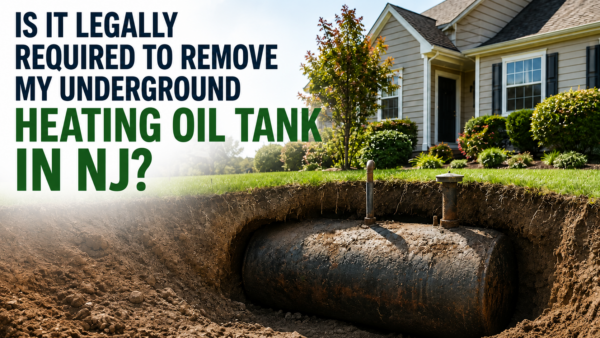
Is It Legally Required to Remove My Underground Heating Oil Tank in NJ?
Quick Answer
Most residential underground heating oil tanks (UHOTs) in New Jersey are not required to be registered with NJDEP, and there is no statewide law forcing homeowners to remove a tank simply because they own one. That said, “unregistered” does not mean “unregulated.” Liability under the New Jersey Spill Compensation and Control Act still applies, and removal becomes effectively required when a tank leaks, when a home is being sold, when a tank is taken out of service without proper documentation, or when a municipality has its own local requirements.
Because most residential underground heating oil tanks fall outside NJDEP’s registration system, there may be no official state record showing when the tank was installed, whether it was maintained, or what condition it is in. That lack of documentation is exactly what creates problems for homeowners, buyers, lenders, and attorneys down the line.
Why Your Residential Oil Tank May Not Be in NJDEP Records
Here is the detail that surprises many New Jersey homeowners: NJDEP’s underground storage tank registration program, governed by N.J.A.C. 7:14B, primarily applies to commercial and larger-capacity underground storage tanks. Most residential underground heating oil tanks, typically 2,000 gallons or less and serving one- or two-family homes, fall outside this registration requirement.
That means your tank may have no NJDEP registration number, no state file, and no official record tracking its age, condition, installation date, or history. At first, that may sound like good news. Less paperwork, less oversight, less hassle.
In reality, it can create a bigger problem.
A few important things follow from that exemption:
- No registration means no official installation-date record. If you do not know when your tank was installed, NJDEP likely does not know either.
- No registration means no automatic NJDEP inspection trigger. Unlike regulated commercial tanks, no state agency is routinely checking the condition of your residential tank over time.
- No registration does not mean no liability. If your unregistered tank leaks, you are still responsible for cleanup under New Jersey environmental law.
- No registration makes a clean history harder to prove. Without a state file, the burden falls on you to produce documentation if you sell, refinance, or investigate the property later.
In other words, the registration exemption removes one regulatory checkpoint. It does not remove your responsibility as the property owner.
When Underground Oil Tank Removal Becomes Required in New Jersey
There may not be a blanket statewide rule requiring every homeowner to remove every underground heating oil tank immediately. But there are several common situations where removal becomes legally required, practically unavoidable, or strongly recommended.
1. Your Tank Has Leaked or Is Suspected of Leaking
This is the clearest trigger. If your underground heating oil tank has leaked, removal and remediation obligations may apply whether the tank was registered or not.
Under the New Jersey Spill Compensation and Control Act, a discharge of a hazardous substance, including heating oil, must be reported and addressed. Registration status does not matter. A slow leak from an old steel residential tank can still qualify as a discharge, even if it happened gradually over many years.
The tank does not need to be actively spilling oil into the ground for this to become serious. Many residential oil tank leaks are discovered only after the tank is removed and the contractor finds holes, petroleum odors, stained soil, or contaminated backfill.
Once a release is confirmed, the issue is no longer simply “Should I remove the tank?” The question becomes how the discharge must be reported, investigated, remediated, and documented.
2. You Are Selling the Home
There is no single New Jersey statute that says every unregistered residential underground oil tank must be removed before closing. But in practice, a buried tank often becomes a major obstacle during a sale.
Buyers, attorneys, lenders, title companies, and insurance carriers care less about whether the tank was registered with NJDEP and more about whether an underground environmental liability exists on the property.
Common issues during a sale include:
- A buyer’s tank sweep identifies a buried tank or underground anomaly
- The seller discloses an abandoned or active underground heating oil tank
- There is no documentation showing the tank was properly removed or closed
- The buyer’s lender requires removal, soil testing, or closure documentation before approving the loan
- The buyer’s attorney recommends holding funds in escrow until the tank issue is resolved
FHA and VA loans often create additional pressure because unresolved underground tanks can create financing issues. Conventional lenders may also require documentation before closing.
So while removal may not be technically required by one statewide law in every sale, it often becomes effectively required if the buyer, lender, attorney, title company, or municipality will not move forward without it.
3. Your Tank Has Been Taken Out of Service
An underground heating oil tank that is no longer in use still needs to be handled properly. “Out of service” does not mean “out of mind.”
If your home was converted from oil to gas, propane, electric, or another heat source, the old underground tank may still be buried on the property. If it was never removed or properly closed, that tank can remain a liability for years.
This is especially common in New Jersey homes where prior owners converted to gas decades ago and left the buried oil tank behind. Sometimes the tank was emptied. Sometimes it was filled. Sometimes no one knows what happened because no paperwork exists.
An undocumented, out-of-service tank can become a major problem during a sale because there is no reliable proof of:
- When the tank stopped being used
- Whether it was emptied
- Whether it was cleaned
- Whether it leaked before being taken out of service
- Whether the soil around it was ever checked
- Whether the work was approved by the municipality
If a tank has been taken out of service, full removal is usually the cleanest way to create the documentation future buyers, attorneys, and lenders want to see.
4. Your Municipality Requires Removal, Inspection, or Documentation
New Jersey municipalities can have their own requirements for residential oil tanks. This local layer is where many homeowners get caught off guard.
Some towns require permits before oil tank removal. Some require inspections. Some may require documentation before issuing a certificate of occupancy or allowing a property transfer. Some may have specific rules around abandonment, backfill, soil testing, or closure documentation.
Because residential UHOTs are often not registered with NJDEP, your town’s construction, building, fire, or health department may be the only authority with any accessible record of prior tank work.
Common municipal requirements may include:
- Permits for underground heating oil tank removal
- Inspection during removal or closure
- Tank documentation before a certificate of occupancy
- Soil testing requirements after removal
- Specific procedures for abandonment-in-place
- Proof that the tank was emptied, cleaned, and disposed of properly
The only reliable way to know what applies to your property is to check with your local municipal office or work with a contractor who regularly pulls permits in that town.
5. Your Tank Is at the End of Its Usable Life
Even if your tank has not leaked yet, age matters. Many single-wall steel underground heating oil tanks installed before 1990 are now well past their expected service life. In many cases, the homeowner does not know when the tank was installed because there is no state registration record and no prior paperwork from the seller.
That uncertainty is one reason many New Jersey homeowners choose proactive removal. An old underground tank that is quietly corroding is not being monitored by NJDEP, and it may not show any obvious signs of failure until the damage has already occurred.
Removing an aging underground tank before it leaks is almost always less expensive and less stressful than dealing with soil remediation after a discharge is discovered.
What the NJ Spill Compensation and Control Act Means for an Unregistered Tank
The New Jersey Spill Compensation and Control Act is where the “my tank was never registered” argument stops mattering.
The Act establishes liability for discharges of hazardous substances, including petroleum products such as heating oil. If your tank leaks and contaminates soil or groundwater, the property owner can be responsible for cleanup costs regardless of whether the tank was registered, whether the leak was intentional, or whether the owner knew the tank existed when they bought the home.
Practically speaking, this means that if contaminated soil or groundwater is discovered on your property, you may be responsible for funding the investigation, reporting, cleanup, testing, and closure process.
This is also where missing documentation becomes a real problem. If the tank was never registered, never inspected, never removed, and never properly closed, there may be no official record establishing:
- When the tank was installed
- When it stopped being used
- Whether it was ever emptied or cleaned
- Whether it leaked before you owned the property
- Whether any prior owner attempted to abandon it
Until proper closure or removal documentation exists, the liability concern can continue to follow the property.
UHOT Abandonment: When It Is Legal and When It Creates Problems
Abandonment-in-place can be a legal decommissioning option in New Jersey under specific conditions. In general, abandonment means the tank is emptied, cleaned, filled with an approved inert material such as sand, concrete slurry, or foam, and documented through the appropriate local process.
However, abandonment is often misunderstood.
Abandonment does not mean the tank disappears. It remains underground. It also does not automatically eliminate future buyer, lender, or liability concerns.
Here is what abandonment does not do:
- It does not remove the tank from the property
- It does not prove the tank never leaked before abandonment
- It does not release you from liability if contamination is found later
- It does not satisfy every buyer, lender, or title company
- It does not provide the same marketability as complete removal
Abandonment tends to make the most sense when physical removal would cause major structural disruption, such as when a tank is located beneath a building addition, under a finished basement slab, or in another location where excavation is unusually difficult or damaging.
Even then, the documentation must be thorough. If your tank was never registered with NJDEP, the abandonment report may become the only official record that ever exists for that tank. That makes the quality of the closure documentation extremely important.
For most homeowners, especially those planning to sell, removal is usually the better long-term option. Removal gives you a cleaner and more verifiable outcome: no tank left in the ground, an opportunity to inspect the tank and soil, and stronger documentation for future buyers.
Municipal Oil Tank Ordinances in Northern NJ: The Local Layer
Municipal rules are one of the most important parts of the oil tank removal process in New Jersey. State registration exemptions do not eliminate local permitting or inspection requirements.
In many towns, the local construction, building, fire, or health department will have specific procedures for residential oil tank work. Requirements vary, which is why homeowners should not rely on general statewide assumptions.
Examples of local requirements may include:
- A permit before underground tank removal
- Inspection by a municipal official during or after removal
- Tank closure documentation before a certificate of occupancy
- Specific backfill or abandonment material requirements
- Soil testing if staining, odor, or holes are observed
- Submission of disposal records or contractor certification
This local oversight matters in real estate transactions. Even if a buyer and seller agree on how to handle the tank, a town may still require documentation before allowing the sale, occupancy change, or permit closeout to move forward.
The safest move is to identify local requirements early, before the property is under contract or before a closing deadline is approaching.
Why Older NJ Homes Face Higher Underground Oil Tank Risk
New Jersey has a large stock of older homes that were built before natural gas service became common in many areas. For decades, heating oil was the standard fuel source. As a result, underground heating oil tanks are common throughout the state, especially in older suburban and rural communities.
Many of these tanks were installed long before today’s environmental standards, and many were never registered with NJDEP. A tank installed in the 1960s, 1970s, or 1980s may now be far beyond its practical lifespan.
New Jersey’s geography adds another concern. In some areas, groundwater is relatively shallow. In others, fractured bedrock, glacial soils, clay layers, or sensitive aquifers can affect how contamination moves through the subsurface. A small leak from an old steel tank can create a larger environmental issue if petroleum reaches soil layers or groundwater pathways that allow it to spread.
For homeowners, this does not mean panic. It means proactive assessment is valuable. If you know or suspect there is an underground heating oil tank on your property, it is better to understand the condition of that tank now than to discover a problem during a buyer’s inspection, lender review, or municipal permit process.
How ERC Environmental Handles Underground Oil Tank Questions in NJ
ERC Environmental has spent more than 30 years handling oil tank removal, soil investigations, remediation work, and oil-to-gas conversion projects throughout New Jersey. We have worked with countless homeowners who have unregistered, undocumented, abandoned, or aging underground heating oil tanks.
Our job is to give you a clear answer about what you are actually dealing with, not to sell you work based on assumptions.
Here is how we approach these situations:
- Transparent pricing: You know the cost to remove your underground oil tank before work begins, whether your tank has paperwork or none at all.
- Full-service capability: We handle tank removal, soil testing, remediation, and oil-to-gas conversion support, so you are not coordinating multiple contractors.
- Documentation from day one: Since an unregistered tank may have no prior record, we make sure the documentation we create becomes a reliable record going forward.
- Honest assessment: If your tank does not need to come out immediately, we will tell you. If it does, we will explain exactly why.
- New Jersey experience: We understand the municipal, regulatory, real estate, and environmental issues that affect residential oil tank decisions in this state.
Whether you are selling a home, converting from oil to gas, dealing with an old abandoned tank, or simply trying to understand your risk, ERC Environmental can help you figure out the right next step.
Frequently Asked Questions About Underground Heating Oil Tank Removal in NJ
Do I need to register my underground heating oil tank with NJDEP?
Most residential underground heating oil tanks, generally 2,000 gallons or less and serving one- or two-family homes, are exempt from NJDEP’s UST registration requirements under N.J.A.C. 7:14B. That exemption means there may be no state record of your tank’s existence, age, or condition. However, exemption from registration does not eliminate liability if the tank leaks.
If my tank is not registered with the state, am I still liable if it leaks?
Yes. Registration status does not determine liability under the New Jersey Spill Compensation and Control Act. If an unregistered underground heating oil tank leaks and contaminates soil or groundwater, the property owner may be responsible for investigation, cleanup, and documentation costs.
Does selling my home require removal of an unregistered oil tank?
There is no single statewide rule that automatically requires every unregistered underground oil tank to be removed before a sale. However, buyers, lenders, attorneys, title companies, insurance carriers, and municipalities often require removal or documented closure before the transaction can move forward. In practice, removal often becomes necessary during the sale process.
What happens if my unregistered tank was abandoned years ago with no paperwork?
This is a common problem in New Jersey. Without registration records or closure documentation, there may be no official proof of when the tank was taken out of service, whether it was cleaned, whether it was filled properly, or whether the surrounding soil was evaluated. In many cases, removal and testing are the best way to establish a clean record before a sale.
How do I know if my municipality regulates unregistered residential oil tanks?
Contact your local construction, building, fire, or health department, or work with a contractor who regularly pulls permits in your town. Municipal requirements vary, and local rules may require permits, inspections, closure documentation, or specific removal procedures regardless of whether the tank was registered with NJDEP.
Find Out Whether Your Underground Oil Tank Needs Removal
If you are unsure whether your underground heating oil tank requires removal, whether it was ever documented, or what liability you may be carrying, the best first step is a clear conversation with an experienced contractor.
ERC Environmental helps New Jersey homeowners understand what is actually required, what is recommended, and what documentation is needed to protect the property going forward.
Call 877-440-8265 or request a quote online. No pressure. No guesswork. Just straight answers.
Or fill out the form below and we’ll respond within one business day