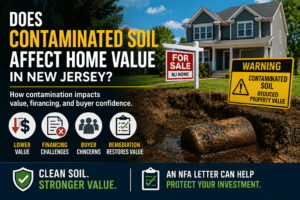
Does Contaminated Soil Affect Home Value in New Jersey?
How Soil Contamination Impacts Property Value, Financing, and Buyer Confidence
You just found out there’s contaminated soil on your property. Maybe a buried oil tank leaked. Maybe a test came back with numbers that alarmed your real estate agent. Now the question every homeowner asks next is the same: what does this do to my home’s value?
The answer isn’t always what people fear. Contamination is a problem, but it’s a solvable one. And in New Jersey, where the regulatory process is well-defined and documentation carries real weight, a remediated property can recover significant value. Here’s what you actually need to know.
Quick Answer
Yes, active soil contamination affects home value in New Jersey. Buyers, lenders, and appraisers treat open environmental cases as financial liabilities. The impact varies based on contamination severity, whether an NJDEP case is open, and how close the property is to closing a remediation.
Key takeaways:
- Unresolved contamination can reduce sale price by 10%-30% or kill deals entirely
- Properties with a closed NJDEP case and a No Further Action (NFA) Letter typically recover most or all of their market value
- Full remediation is the most reliable way to restore buyer confidence and lender approval
- Documentation, not just cleanup, is what moves the needle with appraisers and underwriters
How Unresolved Contamination Changes the Value of a New Jersey Home
Let’s start with what homeowners really want to know: how bad is this, and how permanent is the damage?
The answer depends heavily on where the contamination stands in the remediation process. There’s a big difference between an untouched buried tank that’s been leaking for years and a site that’s been excavated, tested, and closed by NJDEP.
Here’s how contamination affects value at different stages:
Discovered but untreated:
- Buyers will demand price reductions, escrow holdbacks, or walk away entirely
- Most conventional lenders (FHA, VA, conventional) will decline to finance the property
- Value impact: potentially 15%-30% reduction, or the deal simply doesn’t close
Active NJDEP remediation case open:
- Property can still sell, but disclosure is mandatory under New Jersey law
- Buyers assume remediation risk, which typically means a lower offer
- Some specialized buyers and investors will purchase, but at a discount
Remediation completed with NFA Letter:
- Marketability is restored in most cases
- Lenders are more likely to finance with proper documentation
- Appraisers can assess value without the environmental liability cloud
The biggest misconception we hear is that contamination permanently ruins a property’s value. For the vast majority of residential oil tank leak scenarios, that’s simply not true.
How Lenders and Appraisers Treat Environmental Cases in NJ
Banks are not in the business of taking on environmental risk. If an appraiser flags a contamination issue, or if it surfaces during a title search, the lender’s underwriter will require resolution before issuing a mortgage commitment.
In practice, this means:
- FHA and VA loans almost always require an NFA Letter or equivalent documentation before closing
- Conventional loans follow Fannie Mae and Freddie Mac guidelines, which require appraisers to note environmental hazards and may require remediation as a condition of financing
- Cash buyers can close without lender requirements, but they’ll use the contamination as leverage in price negotiation
Appraisers are required to note known environmental hazards in their reports. An open NJDEP case, a failed soil test, or even the presence of an abandoned underground storage tank can trigger a flagged appraisal, which stops a conventional sale in its tracks.
The clean solution is cleanup. Not price reduction theater. Not an as-is sale at a 25% haircut. Proper remediation with closed documentation is what restores normal marketability.
One thing worth understanding: title insurance companies in New Jersey are increasingly sophisticated about environmental red flags. Even when a buyer and seller agree on price, title issues tied to contamination can delay or derail closings independent of the lender’s position. Getting ahead of this with a complete remediation file, not just a verbal assurance, is what keeps closings on schedule.
The Role of an Active NJDEP Case in a Property Sale
In New Jersey, when a contamination discharge is reported or discovered, NJDEP’s Site Remediation Program assigns a case number and tracks the remediation. Sellers are legally required to disclose this to buyers.
Under the New Jersey Spill Compensation and Control Act and related real estate disclosure laws, failing to disclose a known environmental condition, including an active NJDEP case, exposes sellers to significant legal liability.
What an active case means for your sale:
- It is a matter of public record, searchable in NJDEP databases
- Buyers’ attorneys and home inspectors routinely run NJDEP case searches
- Title companies will flag it during the search process
- It signals to buyers that the property carries unresolved liability
Closing a case requires completing remediation to NJDEP standards and receiving a No Further Action (NFA) Letter, the document that officially certifies the site has been cleaned up. Once that letter is in hand, the case is closed and the property’s record is cleared.
For detailed information on NJDEP’s standards, you can review the NJDEP Site Remediation Program guidance and the New Jersey Soil Remediation Standards directly.
What Happens to Home Value After Soil Remediation Is Complete
Here’s the part of this conversation that doesn’t get talked about enough: remediated properties in NJ routinely sell at or near full market value.
Why? Because the remediation process, when properly documented, removes the uncertainty that was dragging down value in the first place. An NFA Letter is not just an environmental clearance. It’s a financial instrument that restores a property’s financeability and marketability.
What documentation matters to buyers, lenders, and appraisers:
- NFA Letter from NJDEP (the gold standard)
- Licensed laboratory soil and groundwater test results showing levels below residential standards
- Tank removal or decommissioning certification
- Chain of custody documentation for all soil sampling
- Remediation contractor reports showing methods used and materials removed
Properties that go through full remediation, with clean documentation, typically see value recovery to within 2%-5% of comparable unaffected properties. That’s dramatically better than the 15%-30% haircut that comes with leaving contamination unresolved.
The timeline matters here too. A well-managed remediation on a standard residential heating oil case can move from excavation to NFA Letter in a matter of months. That’s a meaningful timeline if you’re planning to sell in the next year or two, and it’s far shorter than the years-long drag of an unresolved NJDEP case sitting on a property’s record.
The EPA’s Underground Storage Tank program and NJDEP both publish guidance on what constitutes adequate cleanup, and understanding those standards is what separates a remediation that closes cleanly from one that drags on.
What We See Most Often in New Jersey Homes Dealing with Soil Contamination
ERC Environmental works across New Jersey for remediation work. New Jersey has a specific profile when it comes to oil tank contamination:
- Many homes were built between the 1940s and 1970s and heated exclusively by oil for decades
- Underground storage tanks (USTs) from that era were typically single-wall steel, prone to corrosion and slow leaks that went undetected for years
- Soil types in the region vary from sandy glacial soils (which allow contamination to migrate quickly) to clay-heavy soils (which contain contamination but complicate excavation)
- A significant number of contamination discoveries happen during real estate transactions, triggered by a pre-sale soil test or tank inspection
The good news: most residential oil tank leaks we encounter involve petroleum hydrocarbons (PHCs), primarily heating oil, that are well within the scope of standard excavation and soil removal. They’re not simple, but they’re solvable.
New Jersey’s residential soil cleanup standard for Extractable Petroleum Hydrocarbons (EPH) is 5,300 mg/kg, a threshold set by NJDEP. Many residential leak sites, when caught and addressed in a timely manner, don’t require extensive remediation to meet that standard. Understanding the actual numbers, rather than worst-case assumptions, matters a great deal to the final remediation cost and timeline.
For reference, the official NJDEP residential soil cleanup criteria can be reviewed at the NJDEP Soil Remediation Standards page.
How ERC Environmental Documents and Closes Contamination Cases in New Jersey
ERC Environmental has been handling oil tank removal, soil remediation, and NJDEP case management in New Jersey for over 30 years. Here’s how we approach contamination cases differently:
- Transparent pricing. We quote the job based on what we find, not what we can upsell later. You know the number before we start.
- We tell you when you don’t need remediation. If a soil test comes back clean, we tell you that and save you money. Our goal is the right outcome, not the biggest invoice.
- Full documentation chain. Every job produces a complete file: tank removal or decommissioning certification, soil sample results, lab chain of custody, and NJDEP correspondence. That documentation is what closes cases and satisfies lenders.
- NJDEP case management. We don’t just dig and leave. We handle the NJDEP reporting, coordinate with the assigned case manager, and guide the remediation to an NFA Letter.
- Fast scheduling. We understand that delays in contamination cleanup can cost you a sale. We respond quickly and move cases forward.
Our service area covers all of New Jersey for remediation work.
Frequently Asked Questions: Contaminated Soil and Home Value in NJ
Can I sell my NJ home if there’s an open NJDEP contamination case?
Yes, but you must disclose it, and it will affect your sale. Most conventional buyers and lenders will require resolution. Some cash buyers will purchase with an active case, but typically at a significant discount. Resolving the case before listing almost always results in a better outcome.
How much does contaminated soil actually devalue a home?
Unresolved contamination typically reduces offers by 15%-30%, or prevents financing entirely. Properties with completed remediation and an NFA Letter generally recover to within 2%-5% of comparable clean properties. The actual impact depends on contamination severity, soil type, and how much of the remediation is already complete.
What is a No Further Action Letter and why does it matter?
An NFA Letter is NJDEP’s official certification that a contaminated site has been cleaned up to applicable standards and no further remediation is required. For real estate purposes, it’s the document that closes the NJDEP case, satisfies lenders, and restores normal marketability. It’s the finish line.
Does soil remediation always fix the value problem?
In the vast majority of residential oil tank cases, yes. Full remediation with proper documentation is the most reliable path to restoring a home’s market value. There are edge cases involving extensive groundwater contamination or third-party liability that are more complex, but standard residential heating oil leaks are well within the scope of established remediation methods.
Do I need a licensed professional to handle NJDEP remediation in NJ?
Yes. Certain phases of New Jersey’s remediation process require involvement of appropriately licensed professionals. NJDEP’s Site Remediation Program outlines the applicable requirements, including when a Licensed Site Remediation Professional (LSRP) must be engaged for site investigation and remediation oversight.
Dealing with Contaminated Soil in NJ? Here’s How to Stop It from Costing You the Sale
Most homeowners who call us aren’t sure what they’re dealing with yet. They had a soil test result they don’t fully understand, or a real estate agent flagged something during a pre-sale inspection, or they’ve just discovered there’s an old tank on the property that nobody ever talked about.
That uncertainty is usually the hardest part. The remediation itself, in most residential cases, is more straightforward than people fear.
If you’re in that position right now, the most useful thing you can do is get a clear picture of where you actually stand. What’s the contamination level? Is there an open NJDEP case? What would remediation realistically involve? Those answers exist, and they’re a lot less scary with actual data in hand.
ERC Environmental has been working through exactly these situations with NJ homeowners for over 30 years. Reach out and we’ll tell you honestly where you stand, what it will cost, and what the path to closure looks like.
Serving all of New Jersey counties for soil remediation and environmental services.
Call ERC Environmental or fill out our contact form to get a transparent quote.
Or fill out the form below and we’ll respond within one business day