What Happens If an Underground Oil Tank Leaks in New Jersey?
You just found out your underground oil tank leaked. Maybe a contractor found staining during removal. Maybe your yard smells like fuel oil. Whatever brought you here, you want the same thing every homeowner in this spot wants: a straight answer on what happens now, what it costs, and how long it takes. Here is the honest, step by step version, built for New Jersey homeowners specifically.
Quick Answer: If your underground oil tank leaks in New Jersey, the tank must be removed, the leak reported to the NJDEP, and the soil tested and remediated if contamination is confirmed. Most residential cases fall under NJDEP’s Unregulated Heating Oil Tank program and close with a No Further Action letter once cleanup is documented. Costs typically range from $3,000 to $15,000 dollars for straightforward cases, with most homeowners paying out of pocket. At ERC Environmental, we handle the tank removal and coordinate the remediation with transparent pricing and no guesswork.
How Bad Is It, Really?
Before cost or timeline, every homeowner asks the same question first: how bad is the contamination?
It is a fair question, and it is impossible to answer honestly without testing. But here is what determines the answer.
What decides the severity of a leak:
- How long the tank was leaking before anyone noticed
- The size of the hole or crack, and where on the tank it formed
- Local soil type, since sandy soil lets oil spread faster than clay
- How close the tank sits to your foundation, well, or property line
- Whether the plume has reached groundwater
Most residential leaks are smaller than people fear. A slow pinhole leak caught within a year or two usually stays contained to a pocket of soil around the tank. A tank that sat leaking for a decade under a fill pipe is a different story.
Here is the part that actually matters for you: you cannot know which situation you are in until a certified contractor pulls the tank and a lab tests the soil. Anyone who quotes you a firm remediation price before testing is guessing, and that guess is rarely in your favor.
Is it dangerous to your family right now?
This is the second question people ask, usually right after severity. In most cases, no, not in the way people fear. Soil contamination around a tank is a property and environmental issue that needs to be addressed properly, but it is rare for a residential leak to create an immediate health emergency for people living in the home. Vapor intrusion into living space is uncommon with typical residential leak sizes, though it is one more reason testing matters instead of guessing. If you smell strong fuel odors indoors, that is worth addressing quickly, and a qualified contractor can help you figure out whether it is a ventilation issue, a fresh spill, or something else entirely.
What Actually Happens, Step by Step
This is the sequence, start to finish, for a typical New Jersey residential leak.
Step 1: Confirm the leak
A contractor certified for underground storage tank closure inspects the tank during removal, or you notice signs like a persistent oil odor, a dead patch of grass, or oil sheen in a sump pump. Visual staining on the tank exterior or in the excavation is usually the first confirmation. Sometimes the tank looks fine from outside and the leak only shows up once soil around it is exposed, which is one more reason a proper removal, not a quick visual check, is what actually answers this question.
Step 2: Report it
A confirmed discharge from a heating oil tank must be reported to the NJDEP’s Unregulated Heating Oil Tank program. In New Jersey, that means calling the DEP Hotline. This is not optional, and it is not a step your contractor should skip on your behalf without telling you. Reporting opens what NJDEP calls a case. That case number can feel alarming the first time you see it, but it simply means your remediation is now on record. It is the start of the process, not a penalty.
Step 3: Remove the tank
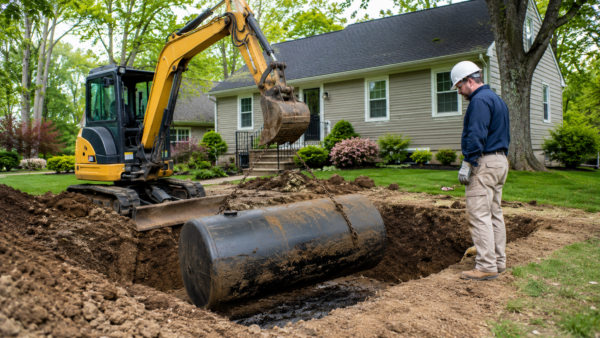
Here is something worth being direct about. There is no legal way to simply patch or repair a leaking underground heating oil tank and leave it in the ground. Once a discharge is confirmed, the tank has to come out. ERC Environmental performs full tank removals. We do not decommission tanks in place, and for a confirmed leak, abandonment in place is not an acceptable path forward anyway.
Step 4: Test the soil
Once the tank is out, soil samples get collected around the excavation and sent to a certified lab. New Jersey’s residential cleanup threshold for petroleum contamination is 5,300 mg/kg of extractable petroleum hydrocarbons (EPH). Soil testing above that number requires remediation. Soil below it can often stay in place with proper documentation.
Step 5: Remediate if needed
If contamination exceeds the threshold, the next step is excavating and removing affected soil, then replacing it with clean fill. The scope depends entirely on how far the plume spreads, which is why step 4 matters so much. In most residential cases this means removing soil from a defined pocket around where the tank sat, not tearing up the entire yard. Confirmatory samples are then taken from the walls and floor of the excavation to prove the remaining soil is clean before backfilling.
Step 6: Get your closure letter
Once remediation is complete and confirmatory samples show clean results, NJDEP issues a No Further Action letter. This document is what closes your case and what future buyers, lenders, and title companies will want to see.
What’s included in a legitimate removal and remediation project:
- Permits and NJDEP hotline reporting
- Tank removal and disposal
- Initial and confirmatory soil sampling
- Excavation and clean fill replacement, if contamination is found
- Documentation package, including your NFA letter
What’s typically NOT included, and worth asking about upfront:
- Structural support if contamination undermines your foundation (steel beams or helical piers are sometimes needed in severe cases, though this is uncommon)
- Landscaping restoration beyond basic grading, depending on the contractor
- Fuel oil replacement or heating system work
What about grants?
NJDEP has historically offered petroleum underground storage tank remediation funding for qualifying homeowners, but availability has been limited in recent years and coverage is never guaranteed to be complete. Do not plan your budget around a grant covering most or all of your cost. Plan for the out of pocket numbers below, and treat any grant approval as a bonus if it comes through.
Cost ranges homeowners can expect:
- Tank removal alone, no contamination found: $1,500 to $3,000 dollars
- Small, contained leak: $3,000 to $6,000 dollars
- Moderate contamination requiring standard excavation: $6,000 to $15,000 dollars
- Severe cases involving groundwater or structural concerns: $15,000 dollars and up
Timeline expectations:
- Permits: 5 to 10 business days from application date
- Tank removal: 1 to 2 days
- Soil testing lab turnaround: 1 to 2 weeks
- Remediation, if needed: 1 to 3 days of active work
- NJDEP review and NFA letter: several weeks to a few months, depending on case volume
Red flags to watch for:
- A contractor who quotes a fixed remediation price before soil testing is complete
- Anyone who suggests skipping the NJDEP report to save time or money
- A company that cannot explain what an NFA letter is or when you will receive one
- Pressure to sign a contract the same day you get a quote
Common mistakes homeowners make:
- Assuming a small odor means a small problem, without testing to confirm
- Hiring the cheapest quote without checking that soil sampling is included
- Waiting to report a known leak, which only increases both cost and liability
- Not keeping copies of the case number, lab results, and NFA letter for their own records
What We See in Sussex, Morris, and Warren Counties
Northern New Jersey has a lot of older homes still running on heating oil, which means we deal with this scenario often across Sussex, Morris, and Warren Counties.
A few local patterns worth knowing:
Rural and semi rural properties in Sussex County often have well water, which raises the stakes on groundwater questions. If your property relies on a private well, NJDEP and your contractor should factor well distance into both testing and remediation decisions.
Morris County’s older housing stock, especially homes built before the 1980s, tends to have tanks that were installed with less corrosion protection than modern systems. Age alone is a reason to have a tank inspected even without obvious symptoms.
Warren County’s mix of clay and rocky soil actually works in some homeowners’ favor. Denser soil can slow the spread of a leak compared to the sandy soil common closer to the coast, though it also makes excavation more labor intensive.
Every New Jersey municipality regulates these tanks at the building department level, since residential UHOTs fall outside NJDEP’s standard registration requirements. That local layer matters. Your township’s construction office is often the first place a permit gets pulled, and it is worth knowing your municipality’s process before your project starts, not after.
This is a detail most contractors gloss over. Because your tank is unregulated at the state level, the state’s role kicks in only once a discharge is confirmed. Day to day oversight, including who signs off on the removal permit, sits with your town. Two neighboring towns in the same county can have slightly different paperwork requirements, so it pays to work with a contractor who already knows your specific municipality’s process rather than learning it on your project.
Why ERC Environmental’s Process Matters Here
We have removed and remediated tanks across New Jersey for more than 30 years, and this scenario, a confirmed leak, is one we handle on a regular basis. A few things about how we approach it.
We give transparent pricing once we know what we are dealing with. We are not going to hand you a number before we have tested your soil, because that number would be a guess. But once testing is done, the price in your contract is the price you pay. No change orders for surprises we should have anticipated.
We return calls the same day. When you are mid transaction or worried about your family’s health, waiting a week for a callback is not acceptable. We do not operate that way.
We handle removal, not decommissioning. If a tank has leaked, abandonment in place is not the right call anyway, so our full removal focus lines up with what the situation actually requires.
We document everything. Your case number, your lab results, your NFA letter. You get copies, because you will need them if you ever sell, refinance, or just want peace of mind.
We will also tell you when you do not need us. If your tank tests clean, we say so. Recommending remediation you do not need is not how we do business, and it never will be.
Homeowners often ask why that matters. Simple: a contractor with an incentive to find contamination has an incentive you should not want in the room when your soil results come back. We built our reputation on transparent pricing precisely so there is no financial upside for us in overstating your problem. The number we quote after testing reflects what your soil actually needs, nothing added.
Quick Answers to Common Questions
Does homeowners insurance cover leaking oil tanks?
Usually not. Most standard homeowners policies exclude pollution related damage, and an underground oil tank leak typically falls under that exclusion. Some insurers offer limited oil tank endorsements, so it is worth checking your declarations page, but you should plan for this being an out of pocket cost.
Do I have to report a leak to the state?
Yes. Confirmed discharges from heating oil tanks must be reported to the NJDEP. This applies even if the tank is old, unused, or you did not know it was there when you bought the home.
Can I just patch the tank instead of removing it?
No. Once a leak is confirmed, there is no legal option to repair and leave the tank in place. It has to come out.
Will a leak stop me from selling my house?
Not necessarily, but it will require disclosure and likely delay closing until remediation is documented. A completed NFA letter resolves most buyer and lender concerns.
How do I know if contamination has reached groundwater?
Soil and, if needed, groundwater monitoring wells determine this. It is not something you can assess by smell or visual inspection alone, which is why testing matters more than guessing. The EPA’s underground storage tank program notes that leaking tanks are a common source of groundwater contamination nationwide, which is exactly why New Jersey requires prompt reporting and testing rather than a wait and see approach.
What to Do Next
If you are dealing with a confirmed or suspected oil tank leak in New Jersey, the fastest way to get clarity is to have the tank properly removed and tested. ERC Environmental provides same day callbacks, transparent pricing once testing is complete, and full documentation from start to NFA letter. We are not going to upsell you on work you do not need, and we are not going to leave you guessing about what happens next.
Contact us here or call 877-440-8265 for more information on underground tanks and soil clean up.
Or fill out the form below and we’ll respond within one business day