Do You Have an Underground Oil Tank? How NJ Homeowners Can Find Out
Quick Answer
Most New Jersey homes built before the 1970s that used oil heat have, or once had, an underground oil tank, often called a UHOT (underground heating oil tank). You can check by pulling your municipal and NJDEP records, looking for fill and vent pipes in your yard, checking your basement for capped oil lines, and hiring a professional for a tank sweep using ground penetrating radar or metal detection. ERC Environmental performs full oil tank removals and new tank installations across New Jersey. We help homeowners confirm what is buried on their property and handle it safely from start to finish. We do not perform decommissioning or abandonment in place. We focus on complete removal.
Quick Answer
Many older New Jersey homes that previously relied on oil heat may still have an active, abandoned, or decommissioned oil tank on the property.
You can start investigating by reviewing municipal and NJDEP records, looking for fill and vent pipes in your yard, checking your basement for capped oil lines, and hiring a qualified professional to conduct a tank sweep using ground-penetrating radar or electromagnetic detection equipment.
Residential heating oil tanks that fall outside New Jersey’s regulated underground storage tank program are commonly called Unregulated Heating Oil Tanks, or UHOTs.
If a tank is confirmed, ERC Environmental performs complete oil tank removals and new tank installations throughout New Jersey. We handle the work safely from start to finish. We do not decommission tanks or abandon them in place; we focus on complete removal.
What Homeowners Actually Want to Know First
If you are reading this, you probably have one real question: “Do I have an oil tank buried in my yard, and what happens if I do?”
It is a fair question. Oil heat was common throughout much of New Jersey for decades. When homeowners switched to natural gas or aboveground oil tanks, many underground tanks were left in place. Some were never reported. Some appear in municipal or property records. Others are discovered only when a home inspector or tank-sweep technician notices a suspicious pipe or detects something beneath the lawn.
Here is what homeowners usually want to know first:
- Do I actually have an underground oil tank?
- If I have one, am I required to remove it?
- Will it affect my home sale or mortgage?
- How much does underground oil tank removal cost?
- Could the surrounding soil be contaminated?
We will work through each of these questions honestly. No scare tactics—just straightforward answers based on what we see every day in New Jersey.
One point is worth making upfront: having a UHOT does not automatically mean you have a contamination problem. It means there is aging infrastructure on the property that should be properly evaluated. Most tanks we remove are intact. The goal of finding out is to get ahead of a potential issue, not to panic.
How to Check for an Underground Oil Tank Step by Step
Finding out whether you have a buried oil tank does not require guesswork. There is a logical order to the process, and most homeowners can complete the first few steps themselves before calling a professional.
1. Review Your Property Records
Start with the paperwork. This is typically the fastest and least expensive step.
- Review your property deed and closing documents. Older sale records may mention an oil tank, tank removal, or closure certificate.
- Check with your municipal building department. Many New Jersey municipalities maintain permits for oil tank installations and removals.
- Request relevant NJDEP records through the Open Public Records Act if the property has a known environmental history.
- Review your homeowners insurance records. Some policies identify the property’s current or former fuel-oil heating system.
Keep in mind that heating oil tanks serving one- or two-family residences and holding less than 2,000 gallons are generally exempt from NJDEP underground storage tank registration requirements under N.J.A.C. 7:14B.
That means the state may not have a record even when a tank exists. Your municipal building department may be the only local authority with documentation, so do not assume that a clean NJDEP records search confirms that the property never had a tank.
2. Look for Physical Clues in Your Yard
If the paperwork does not provide a clear answer, the property itself may contain useful clues.
- Look for two capped pipes extending a few inches above the ground, usually near the foundation. One may be the fill pipe and the other the vent pipe.
- Check for a metal cap or copper-colored fitting sitting flush with the lawn.
- Look for a noticeable depression or an unusual patch of grass that grows differently from the surrounding lawn. This may indicate previously disturbed soil.
- Walk the perimeter near the area where an older oil-fired boiler or furnace may have connected to the exterior wall.
These clues are not foolproof. Pipes may become buried beneath landscaping, and some tanks were capped at or below ground level without leaving an obvious visual marker.
3. Check Your Basement or Crawlspace
Your basement or crawlspace can reveal additional evidence, especially in an older home.
- Look for a capped or cut copper line entering through the foundation near the location of the current or former furnace.
- Check for a fill or supply pipe passing through the foundation wall toward the yard.
- Look for an older boiler or furnace with oil-burner components, even if the home has since been converted to gas.
If the home was converted from oil to gas heat, determine whether the old oil tank was completely removed or merely decommissioned and left in place. That distinction can become important during a future sale, refinance, or environmental investigation.
4. Hire a Professional Tank-Sweep Provider
If the records and visual inspection do not provide a definite answer, a professional tank sweep is generally the most reliable way to determine whether a buried tank may be present.
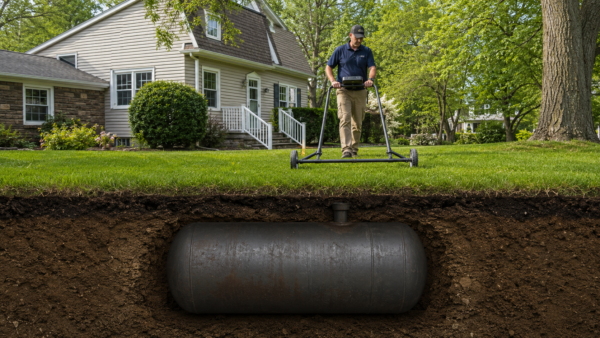
An oil tank sweep may use ground-penetrating radar, electromagnetic locating equipment, or a combination of detection methods to scan accessible portions of the property for buried metal or tank-shaped anomalies.
A trained technician typically scans the areas near the foundation, former heating equipment, and suspected fill-pipe locations while reviewing the readings in real time.
What a Professional Tank Sweep Involves
A typical sweep may take one to two hours, depending on the property’s size, terrain, landscaping, and accessibility. The provider should supply a written report documenting whether a possible tank was detected, along with its approximate location.
This report can provide useful documentation during a home sale, purchase, or refinance. It can also give a current homeowner greater peace of mind.
Tank sweeps are reliable, but no detection method is perfect in every setting. Deep burial, unusual soil conditions, fencing, utilities, reinforced concrete, and other nearby metal can affect the results. A reputable technician should explain any limitations or inconclusive findings rather than make an unsupported assumption.
Cost of an Underground Oil Tank Sweep in New Jersey
Oil tank sweeps in New Jersey generally cost a few hundred dollars, depending on the property’s size and accessibility. That is a relatively small upfront expense compared with the uncertainty of buying or selling a property without knowing whether a buried tank exists.
Many New Jersey real estate transactions now include a tank sweep as part of the buyer’s inspection and due-diligence process.
Warning Signs Worth Taking Seriously
Not every indication of a buried tank means there is a leak, but certain warning signs should prompt a timely professional evaluation:
- A strong heating-oil odor in the basement or near the yard, particularly after heavy rain
- Stained or discolored soil near a suspected fill-pipe location
- Dead or stunted vegetation in a small, isolated section of an otherwise healthy lawn
- An unexplained drop in heating-oil usage when the tank was still active
- Nearby properties with documented tank leaks or a known history of contamination
If you notice any of these warning signs, do not wait for a future real estate transaction to investigate. Contact a qualified environmental professional so the situation can be properly assessed.
Common Mistakes Homeowners Make
We see the same handful of mistakes repeatedly, and most are avoidable:
- Assuming a clean NJDEP search means there is no tank. Residential UHOTs are often exempt from state registration, so an existing tank may not appear in NJDEP records.
- Hiring the least expensive contractor without confirming the scope of work. Tank removal and abandonment in place are very different services with different long-term implications.
- Waiting until a home is under contract to investigate. Discovering a tank during the inspection period creates time pressure and may limit the owner’s available options.
- Treating a clean sweep as an absolute guarantee. Ask the provider about the equipment used, the areas scanned, and any limitations that affected the results.
- Assuming insurance will cover contamination. Heating-oil tank leaks and remediation expenses are not covered under every homeowners policy. Review the actual policy rather than assuming coverage exists.
What Is Included in an Underground Oil Tank Removal?
Understanding the scope of the removal project helps establish realistic expectations before work begins.
Services Generally Included
- Excavation around the underground tank
- Removal of the tank from the ground
- Proper disposal or recycling of the tank
- Backfilling the excavation
- Basic documentation of the removal
Services That May Not Be Included Unless Specified
- Soil sampling and laboratory analysis
- Removal or remediation of contaminated soil
- Municipal permitting fees
- Landscaping restoration beyond basic backfilling
A reputable oil tank removal contractor should explain exactly what the quoted price includes before work begins. The contractor should also explain how the scope and price may change if staining, odors, holes, or contaminated soil are discovered during the removal.
Why Underground Oil Tanks Are Common in New Jersey
New Jersey has a significant amount of older housing stock, and heating oil remained common in many communities well into the 1980s. That history continues to shape what environmental contractors find today.
Underground tanks are frequently discovered at older farmhouses and homes built before natural gas lines reached more rural areas. Many of these properties also rely on private wells, potentially increasing the concern if a leaking tank is located near a water source.
Converted suburban homes present another common scenario. A previous owner may have switched from oil to natural gas decades ago while leaving the original tank buried on the property, sometimes without complete closure documentation.
Both rural properties and homes in older town centers regularly appear in tank-removal service calls. Many tanks were installed before modern documentation and environmental tracking practices existed.
Soil and groundwater conditions also vary by municipality. That is why homeowners should confirm the property’s tank status through records and fieldwork rather than relying on a neighbor’s experience or a generic online estimate.
The NJDEP Site Remediation Program provides guidance on how contamination is investigated and addressed when a discharge is discovered. Municipal and county agencies may also have information about local permits, known contamination, historic fill areas, or previous remediation projects.
Why ERC Environmental’s Approach to Oil Tank Work Is Different
We want to be upfront about something many companies in this industry do not clearly explain: not every environmental contractor performs the same type of work.
ERC Environmental specializes in complete oil tank removal and new tank installation. We do not decommission tanks through abandonment in place, which involves filling a tank with sand, foam, gravel, or another approved material and leaving it underground.
We believe complete removal is usually the better long-term answer for homeowners because it eliminates the uncertainty that comes with leaving aging infrastructure buried on the property.
Here is what working with ERC Environmental looks like:
- Transparent pricing: You know the expected cost before work begins rather than learning about an unexpected change order at the end.
- Fast scheduling and responsive communication: We answer the phone and return calls the same day in most cases.
- More than 30 years of experience: Our team has extensive experience removing oil tanks and addressing contaminated soil throughout New Jersey.
- Complete documentation: We document the removal and provide soil-sampling results when testing is applicable, creating a paper trail for your records, buyer, attorney, insurer, or lender.
- Plain-language explanations: We explain what we find without burying you in technical terminology.
We will not tell you that every property needs an expensive remediation plan. Most tanks we remove are intact, and the removal is straightforward.
When we do find evidence of a leak, we explain what NJDEP requires and what the realistic next steps look like without unnecessarily inflating the scope of work.
Frequently Asked Questions
How do I know for sure if I have an underground oil tank?
The most reliable method is a professional tank sweep using ground-penetrating radar, electromagnetic detection equipment, or another appropriate locating method. Property records and visual clues are useful starting points, but a professional sweep provides a documented assessment.
Am I required to remove an underground oil tank in New Jersey?
Heating oil tanks serving one- or two-family residences and holding less than 2,000 gallons are generally exempt from NJDEP registration requirements. However, municipal requirements may still apply, and property owners may remain responsible for investigating and remediating any confirmed discharge.
Even when removal is not strictly required, buyers, lenders, attorneys, and insurers may request it as part of a real estate transaction.
Can I sell my house with an underground oil tank still in the ground?
It may be possible, but the tank should be disclosed as required, and many buyers or lenders will request additional documentation, testing, or removal as a condition of the transaction. Addressing the issue before listing can make the sale more predictable.
How much does it cost to remove an underground oil tank in New Jersey?
The cost depends on the tank’s size, depth, location, accessibility, permit requirements, and whether contaminated soil is discovered. ERC Environmental provides transparent quotes following an initial assessment so homeowners understand the anticipated cost before work begins.
Does ERC Environmental decommission tanks instead of removing them?
No. ERC Environmental focuses on complete oil tank removal and new tank installation. We do not offer abandonment-in-place or decommissioning services because we believe complete removal is generally the more responsible long-term solution for homeowners.
Find Out What Is Buried on Your Property
If you suspect that your New Jersey property has an underground oil tank, the smartest step is to get a clear answer rather than continue living with uncertainty.
Start by reviewing your property records, checking the yard and basement for physical clues, and scheduling a professional tank sweep if questions remain.
If a tank is confirmed and you need complete removal or a new tank installation, ERC Environmental offers transparent pricing, responsive scheduling, and more than 30 years of experience throughout New Jersey. No upselling and no guesswork—just a clear path forward.
Contact ERC Environmental or call 877-440-8265 to discuss your property and the next step.
Or fill out the form below and we’ll respond within one business day